
An undergraduate Earth Science course is reshaping students’ understanding of land, responsibility and restoration.
At 9 a.m. on a cool Friday morning, students gather outside the Spencer Ivey Leadership Centre. Before the lecture starts or field tools are lifted, Indigenous educator Clint Jacobs asks everyone to step into a circle. One by one, students share something they are grateful for that day.
Clint goes around the circle placing pieces of sema (tobacco) into each student’s hand. They are asked to speak about their intentions to the earth, offer thanks, and gently sprinkle the tobacco onto the ground.
The act is simple but profound, an offering that acknowledges their intentions and responsibility before entering the land reminding students that learning is a relationship rather than an extraction.
“This isn’t a typical Western course,” Professor Moser says. “The circle lets students share pieces of themselves in a safe, relational way. And the sema becomes a physical reminder that you have responsibilities to other beings.”
This marks the beginning of each class in EARTHSCI 3023: A Field Course in Land Healing and Responsibility. It is an Indigenous-led, Land-led course in collaboration with Indigenous educators and Elders from Bkejwanong Territory (Walpole Island First Nation). Earth Science professor Desmond Moser works closely with Indigenous educator Clint Jacobs to run this course. As the syllabus states, “Indigenous approaches to reciprocity, restoration, invasive species remediation and land stewardship and connections to, and responsibilities to, land and water grounded in both ecology and Indigenous knowledge.”
While the course is fully Indigenous-led and Land-led, this story draws on the perspective of Professor Moser, a non-Indigenous collaborator who has spent more than a decade supporting Indigenous educators and witnessing the impact of the land on Western students.
What is Indigenous-led, Land-led Learning?
The term “land-based learning” has grown increasingly common, but Moser suggests it doesn’t fully capture what happens in this course.
“The land is actually an instructor too,” he says. “It’s Indigenous-led, but it’s also land-led as the land is an equal partner in the learning experience.”
Students learn not just on the land, but from the land. By listening to and observing, they restore habitats and recognize relationships to more-than-human-beings.
This approach comes directly from Anishinaabeg practices from Bkejwanong, one of the most biodiverse regions in the Great Lakes Basin, home to globally imperilled oak savannah, tallgrass prairie, rare wetlands and more than 70 species at risk.
A Course Built Through Relationship
More than ten years ago, professor Moser was teaching a course on tallgrass prairie ecology when he noticed posters in the herbarium lab featuring the very plants he grew up around as a child. Biologist Dr. Jane Bowles, who has since passed, told him the best-preserved prairie remnants were at Walpole Island and offered to introduce him to her friend, Clint Jacobs.
That introduction became the start of this course.
A number of years later, Western University asked Professor Moser to teach an Indigenous Studies course. He refused unless done in collaboration with an Indigenous Educator.
“I can’t teach an Indigenous course, I’m not Indigenous,” he recalls. “I advocated for Western to hire Clint as co-instructor. He became the leader.”
This commitment to Indigenous authority continues to shape the course today.
Learning on the Land: What changes for Students
One of the most transformative aspects of the course is simply being outdoors, working together and using tools.
“Students love being outside," says Moser. “For many non-Indigenous students, it’s the first time they form a real relationship with the land.”
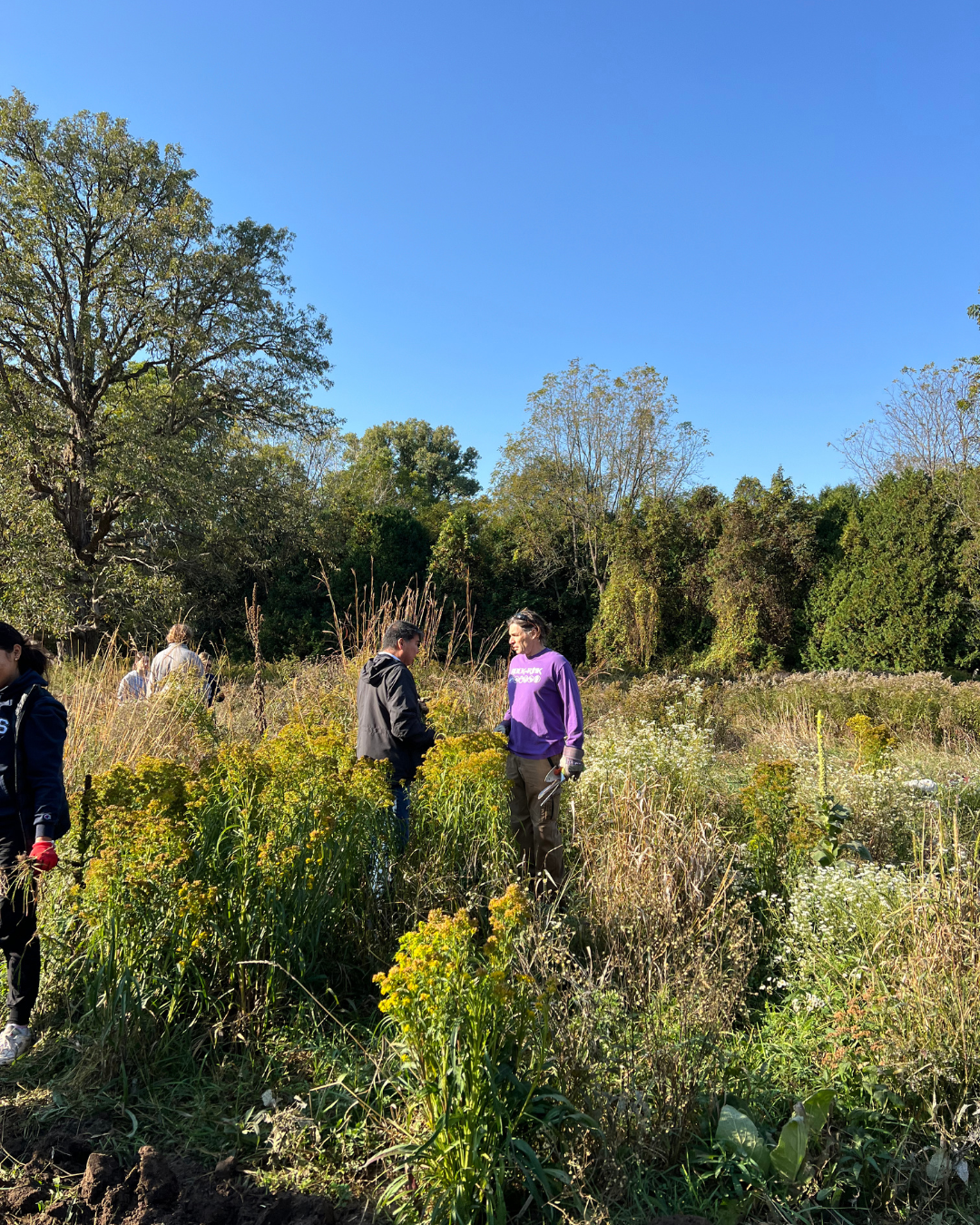
Whether they are mapping habitats, removing invasive species, planting native seeds, or observing the forest along Deshkan Ziibi (the Thames River), students begin to understand restoration not just as ecological work, but as relational responsibility.
Moser often sees the deepest learning not in the moment, but afterward.
“It’s in the reflections where you see the lightbulbs. Students make connections that are deeply meaningful to them.”
Ecological Context of the Learning Environment
Students spend much of the course working in forested and riparian zones along Deshkan Ziibi (Thames River), an area that once formed part of a continuous Carolinian forest and tallgrass prairie. Because of things like farming, industrial activity and urban expansion, the landscape is fragmented into scattered groves and isolated prairie patches. As a result, there is a loss of native species, spread of invasive species, reduced biodiversity, habitat decline and polluted waterways on Western University’s campus.
Through habitat observation, mapping and related research in the process of growing and re-introducing native and endangered plants and trees, students are better able to understand how ecological health and Indigenous cultural survival are intertwined and why restoration is rooted in both scientific knowledge and relational responsibility.
The relationship between Science and Indigenous Knowledge
As a trained geologist, Moser sees no tension between Indigenous knowledge systems and Western scientific approaches. Instead, he views them as deeply interconnected.
“They complement each other,” he says. “They’re just different observational lenses.”
Moser explains that many Indigenous teachings are grounded in the same principles that guide scientific inquiry.
“Indigenous teachings are incredibly scientific,” he explains. “They’re very evidence-based and a lot of science is about finding things you can observe in common, and that’s exactly what these teachings do.”
He points to stories about plant and animal beings that existed long before humans, noting that these align with the fossil record and geological timelines. For Moser, this knowledge is best described not simply as information but as an Indigenous, land-led philosophy rooted in observation, evidence, and respect for the more-than-human world.
This worldview closely mirrors geological thinking, which also situates human life within a vast continuum of land, species and time.
Exposure to the Reserve
For most students, the course disrupts long-held assumptions shaped by limited exposure to Indigenous communities and histories.
“Most non-Indigenous students have never set foot on a First Nation or encountered the lived realities of Indigenous stewardship,” says Moser. “Students are blown away by the natural beauty of Bkejwanong.”
Being on the land and walking through restored prairie, listening to Elders and witnessing ecological relationships in-person grounds an understanding within the student that a traditional classroom cannot offer.
A 100-year vision Learning as a Collective Effort
Western University granted permission for Indigenous-led restoration activities on five parcels of land. The Spencer Tract was chosen because of its species at risk and its location in a floodplain, making it unlikely for Western to develop on it.
This year, Clint showed students how to properly harvest
As Professor Moser puts it,“This course doesn’t exist or have any value unless Clint and community members are leading it.”
Students have often described this course as transformative, an experience that shifts not only how they understand the land, but how they understand themselves.
Clint often says it is “an exercise in love.”
